
Some of the most interesting uses of immersive technology don’t begin with a client brief, a commercial product or even a formal project. Sometimes they start with a problem close to home.
Darragh Collopy of Eirmersive member Duir Design recently began experimenting with a VR spelling app for his son, Orin, who has been diagnosed with dyslexia and dyscalculia.
Orin learns by doing. Traditional spelling lists can be a struggle, but activities that involve finding, moving and interacting with things are a different story. That prompted Darragh to explore whether immersive technology could make weekly spelling practice more engaging and better suited to the way his son learns.
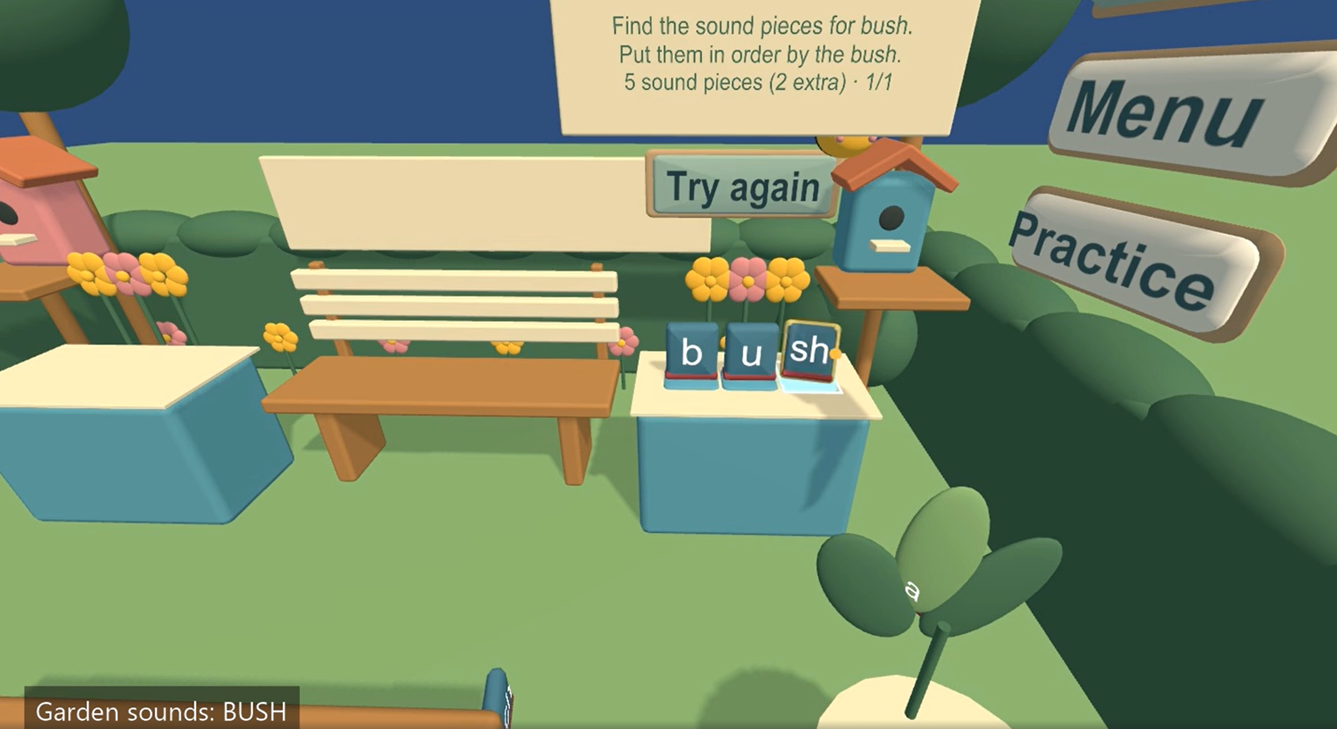
Screenshot courtesy of Darragh Collopy
Built in Unity for the Meta Quest, the early version allows Orin to explore virtual environments such as a bedroom or garden, find letters and sound combinations like “sh” and “ee”, and put them in the correct order. Darragh has also been experimenting with memory and whack-a-mole-style games based around activities Orin already enjoys.
A companion web app allows a parent to add the week's spellings and prepare them for use in the headset, meaning the content can change without rebuilding the underlying experience.
Longer term, Darragh is interested in what this could look like in mixed reality, with letters hidden around Orin's real bedroom or words assembled on his own bed. For now, though, it remains exactly what it started as: an experiment to understand what works for one learner.
AI as an enabler, not the end product
There is another interesting layer to the project: how it is being built.
Darragh has been using OpenAI Codex alongside Unity, connecting the two through MCP. AI is helping him move much more quickly from an idea to something that can actually be put in front of Orin and tested.
As Darragh explains:
“The biggest thing Codex has changed for me is how quickly I can try an idea with Orin. I can describe how I want an activity to feel, work through it with Codex and build a version in Unity. Then I watch Orin play and see what’s worth changing.”
That creates a remarkably short feedback loop between idea, prototype and real-world use.
Sometimes the change is practical, such as moving a letter so that it is easier to reach. At other times, Orin himself takes the experience in a completely different direction. A request to play air hockey or punch the letters can quickly become the inspiration for a new mini-game.
For Darragh, AI is also changing where he spends his own time and energy.
“I can feed it playtest videos and game logs, talk through what I noticed and let it do a lot of the technical heavy lifting. That gives me more room to express my creative side and spend time on the parts I enjoy most, like coming up with new games and seeing what Orin makes of them.”
That point feels particularly relevant as AI tools become embedded in creative and immersive workflows.
For people who may have ideas for immersive experiences but don't see themselves as deeply technical developers, tools like Codex can increasingly help bridge the gap between knowing what you want to create and knowing exactly how to build it.
They don't remove the need for judgement, creativity or testing. In this case, they are allowing Darragh to spend less time wrestling with technical implementation and more time observing, experimenting and responding to the person using the experience.
Why side projects matter
The project is also a useful reminder that experimentation doesn't always have to sit inside a formal R&D programme or commercial brief.
A small personal project can offer the freedom to try something unusual, fail quickly, change direction and follow the user's response. There is no predetermined product roadmap here. The development process is being shaped by something much simpler: does Orin enjoy it, and does it help him learn?
For the Eirmersive community, projects like this are particularly interesting because they show immersive technology being explored from a different starting point. The professional experience is still there, but it is being applied to a personal challenge where curiosity and usefulness come before commercial considerations.
And with AI increasingly taking on some of the technical heavy lifting, there may be more opportunities for people across our community to turn those kinds of ideas into working experiments.
Sometimes the side project can tell us just as much about where immersive technology is going as the day job.
Darragh would love to hear from parents, teachers and Dyslexia Ireland. He’d value input from educators in the Immersive community. What has helped with spelling practice, and what could he build into the app that might benefit Orin? Connect on LinkedIn if you can help.