
Case Study Corner
The podcast that explores state-of-the-art
Immersive projects by Eirmersive Members
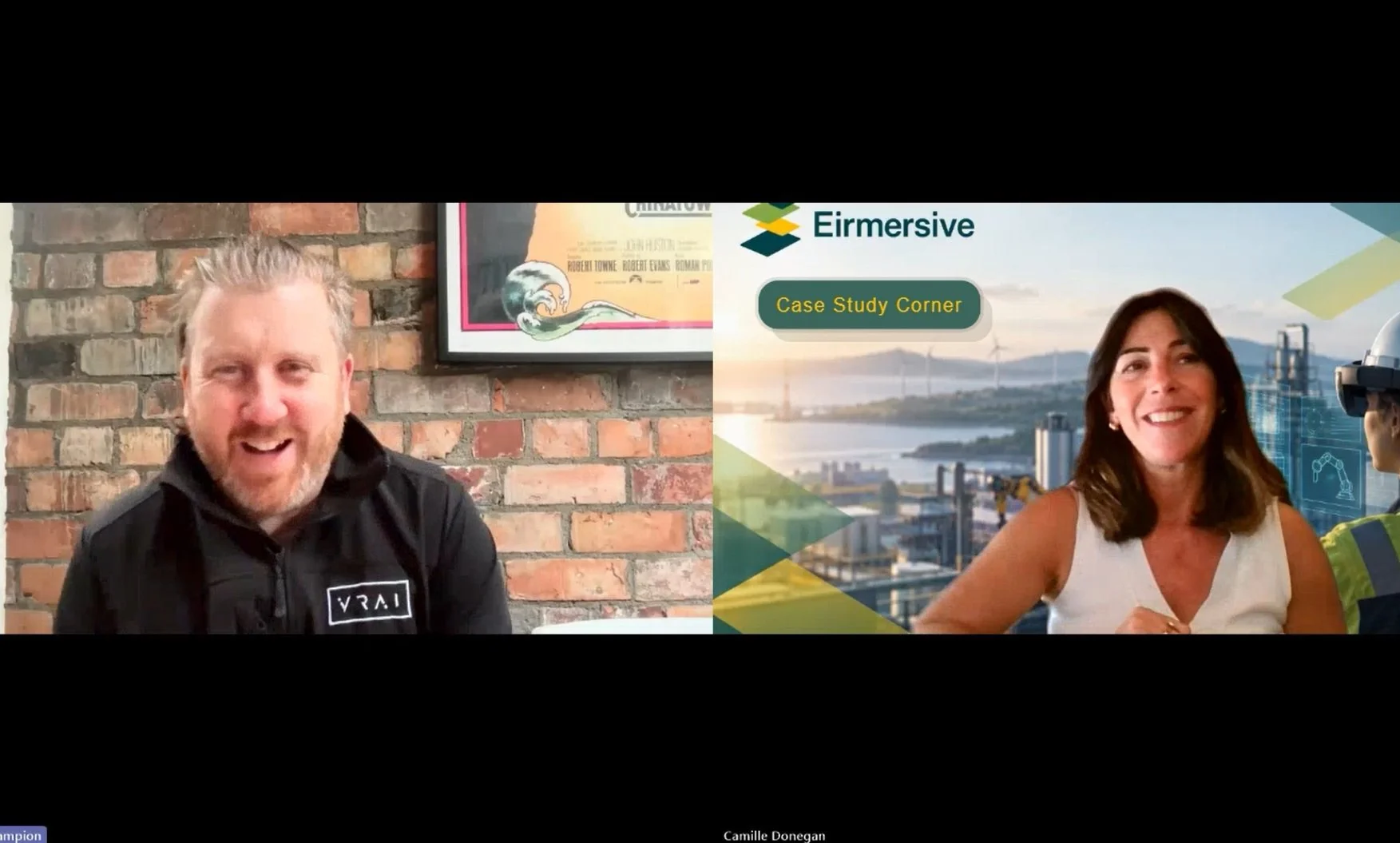
Episode 4: From Simulation to Insight - VRAI on Unlocking the Value of XR Training Data
In this edition of Eirmersive’s Case Study Corner, Camille Donegan speaks with Niall Campion of VRAI about the growing role of data in simulation-based training, and why organisations adopting XR should be thinking about data capture from the very beginning.
VRAI began around ten years ago as a VR training company, initially focused on hazardous, remote and rarely encountered environments. Over time, the team recognised that VR headsets offered something potentially just as valuable as the immersive experience itself: rich contextual information about how a learner behaves during training.
Head tracking, eye tracking and other performance data could provide instructors with a much deeper understanding of what trainees were doing during a simulation and, importantly, help them understand why certain decisions were being made.
That insight ultimately led to HEAT, VRAI’s platform for capturing, storing, analysing and visualising data from training systems. Today, the company’s focus extends beyond VR alone, with HEAT designed to bring together information from different types of simulation devices and, in some cases, live training platforms.
Turning Training Data into Useful Insight
A key theme of the conversation is the difference between simply generating data and making that data genuinely useful.
As Niall explains, instructors are not data scientists and are often already operating under significant time pressure. Adding another layer of information is only valuable if instructors can quickly understand and use it.
HEAT addresses this by capturing information from different simulation systems, standardising it and presenting it through a dashboard designed to make the data easier to interpret.
For instructors, this can mean spending less time manually recording basic information during a session and more time observing higher-order behaviours such as decision-making, communication and interaction with others.
Combining XR with Human Performance Data
The discussion also explores VRAI’s strategic partnership with Varjo and what becomes possible when high-resolution XR hardware is combined with a layer of training analytics.
Varjo’s headsets can generate detailed eye and gaze-tracking data. Through HEAT, that information can be captured alongside simulation data and other inputs to help instructors understand not simply whether somebody completed a task, but aspects of how they performed during it.
One example discussed is cognitive load. VRAI can use eye-tracking data, alongside potential inputs from devices such as heart-rate monitors or smart watches, to provide instructors with an indication of the level of cognitive load experienced by a learner during different points in a training scenario.
The objective is not simply to generate more data. It is to give trainers additional evidence that can help them understand where a learner may be under-challenged or overloaded, and tailor subsequent training accordingly.
For existing Varjo customers, the partnership has also resulted in the HEAT Starter Kit, an introductory version of the platform that allows users to begin capturing and exploring data from their Varjo headset before moving to the fuller HEAT platform.
A Real-World Example with the Irish Defence Forces
The potential benefits become particularly tangible when Niall discusses a project involving VRAI, Varjo and the Irish Defence Forces.
The solution is used in training armoured vehicle drivers, enabling trainees to practise in XR rather than relying exclusively on physical vehicles.
According to Niall, the implementation changed the instructor-to-student ratio from one instructor to three students to one instructor to twelve students, effectively quadrupling instructor capacity.
This is particularly significant in an environment where highly experienced personnel are a limited resource. Increasing the number of trainees that can be supported by an instructor creates an opportunity to return experienced personnel to operational duties while maintaining training capacity.
Niall also cites a saving of approximately €52,000 per three-day training session by reducing the requirement to operate the physical vehicles during that training.
The project has also been independently studied with Learnovation and Trinity College, with Niall highlighting improved retention among learners.
Together, these outcomes underline an important point for organisations evaluating immersive training: the value proposition does not stop at realism or engagement.
XR can form part of a broader training infrastructure where instructor capacity, operational costs, learning outcomes and performance data can all be considered together.

Episode 3: Fourth Reality Showcases Award-Winning Virtual Chemistry Lab
In our third episode of Case Study Corner we spoke with Gary Pearson, Founder of Fourth Reality, about the development of the Immersive ChemLab project created in partnership with Dublin City University (DCU). The conversation explored how virtual reality can transform education and training by providing learners with safe, accessible, and engaging hands-on experiences before entering real-world laboratory environments.
The project centred on a virtual replica of DCU's Atomic Absorption Spectrometer (AAS) laboratory, allowing students to familiarise themselves with equipment, procedures, and analysis techniques through a series of guided VR modules. The solution was designed to address challenges around limited access to specialist equipment and to increase student confidence before practical lab sessions.
During the discussion, Gary shared how the platform combines a digital twin of the laboratory with guided instruction, assessments, analytics, and interactive learning experiences. The project has delivered impressive results, with over 90% of students reporting that they enjoyed the VR experience and many indicating increased confidence and familiarity with laboratory procedures.
“The response has been really positive from staff to students. Over 90% of the students reported enjoying the VR experience overall, which is a real win for us.” — Gary Pearson, Founder of Fourth Reality
The success of the initiative led DCU to release the application as an open-source project, making it freely available through the Meta platform. Since its release, the application has achieved more than 1,000 installations across over 15 countries, extending the impact of the project far beyond its original academic setting.
The episode also explored emerging opportunities for AI within immersive learning environments. Gary highlighted how Fourth Reality is integrating AI-powered tutoring capabilities into its applications, helping learners receive guidance and support in real time as they progress through training activities.
With six new projects currently in development across engineering, social sciences, and chemistry, Fourth Reality continues to demonstrate how immersive technologies can improve learning outcomes while making specialist training more accessible.

Episode 2: The Intelligence Garden at Outernet London, with GLASSEYE
In our second episode of Case Study Corner, Eirmersive CEO Camille Donegan chats with Janet Beck, CEO at GLASSEYE, about The Intelligence Garden, a large-scale immersive experience commissioned for Outernet London, one of the most ambitious digital public spaces in the world.
For organisations exploring immersive technologies, Janet emphasises three key takeaways: prioritise story over spectacle, design for spatial rather than linear experiences, and don’t be afraid to start small. Even at modest scale, immersive technologies can be powerful tools for communicating complex ideas and connecting with audiences in meaningful ways.

Episode 1: Irish Cement, with Emagine
In this first episode of Case Study Corner, Eirmersive CEO Camille Donegan chats with Aaron Jay, CEO & Co‑Founder of Emagine, to explore Rock to Reality — a VR-powered factory tour created for Irish Cement.
Discover how Emagine used immersive storytelling, cinematic capture, 360 imagery, and interactive Unity-based elements to transform Irish Cement’s recruitment and engagement strategy for school leavers and apprentices.