
Volograms Advances Realistic Human Capture with New 4D Gaussian Splatting and GenAI Breakthroughs
Our member Volograms continues to push the boundaries of volumetric capture and AI-driven 3D content creation, sharing two promising research updates that point towards a future where creating realistic digital humans becomes significantly more accessible.
One area of focus is 4D Gaussian Splatting, a rapidly emerging technique for capturing and rendering dynamic, photorealistic human performances. While the technology has generated considerable excitement across immersive media, gaming and virtual production, achieving high-quality results typically requires large, complex camera arrays.
Volograms is working to change that.
In a recent update, founder Rafael Pagés revealed early results from research led by Sascha Kirch, aimed at making 4D Gaussian Splatting work across a much wider range of capture environments, including smaller camera setups and less controlled conditions. Demonstrated using footage captured in Volograms' 12-camera Dublin studio, the results suggest a pathway towards lowering the barriers to high-quality volumetric capture while maintaining visual fidelity.
At the same time, the company is making progress on another challenge facing the immersive content ecosystem: single-view 3D reconstruction.
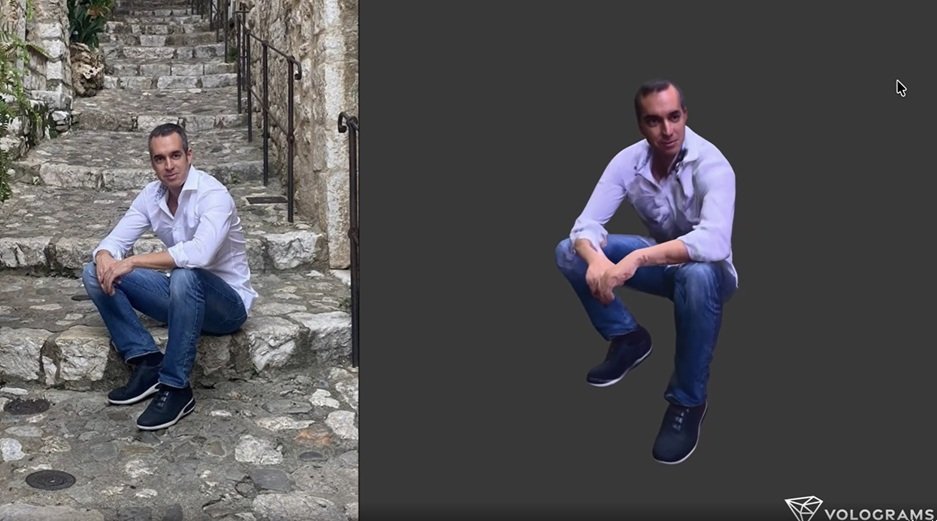
Image via Volograms
While recent Generative AI models have made impressive strides in creating 3D objects from a single image, accurately reconstructing human faces remains a difficult problem. The subtle details that allow us to recognise an individual are often lost, limiting the usefulness of many existing approaches for creating realistic digital humans.
According to Pagés, Volograms has been focused on improving facial accuracy within its own GenAI reconstruction pipeline, producing results that preserve recognisable features far more effectively. Although still a work in progress, the technology is improving rapidly and could help simplify the creation of realistic avatars and digital humans from minimal source material.
Taken together, the two developments reflect a broader trend across the immersive technology landscape. As AI and advanced rendering techniques continue to mature, the industry is shifting from high-cost, specialist capture workflows towards tools that are more scalable, flexible and accessible. Reducing hardware requirements while improving reconstruction quality could have significant implications for sectors ranging from entertainment and virtual production to training, communications and digital twins.
Perhaps most intriguingly, when asked whether the company's improved reconstruction technology could also be applied to video, Pagés responded simply: "working on it."
If successful, that could mark another significant step towards making high-quality volumetric video creation available from increasingly lightweight capture setups.
For now, both projects remain works in progress, but they offer an exciting glimpse into the future direction of human digitisation and immersive content creation, and reinforce Volograms' position at the forefront of innovation in the space.